Fiber Types That Support Gut Health in Long COVID and ME/CFS
In a previous post, I covered why increasing dietary fiber can help with symptoms like fatigue, pain, and inflammation in ME/CFS, fibromyalgia, and long COVID/post-acute sequelae of COVID (PASC). Read more on that here.
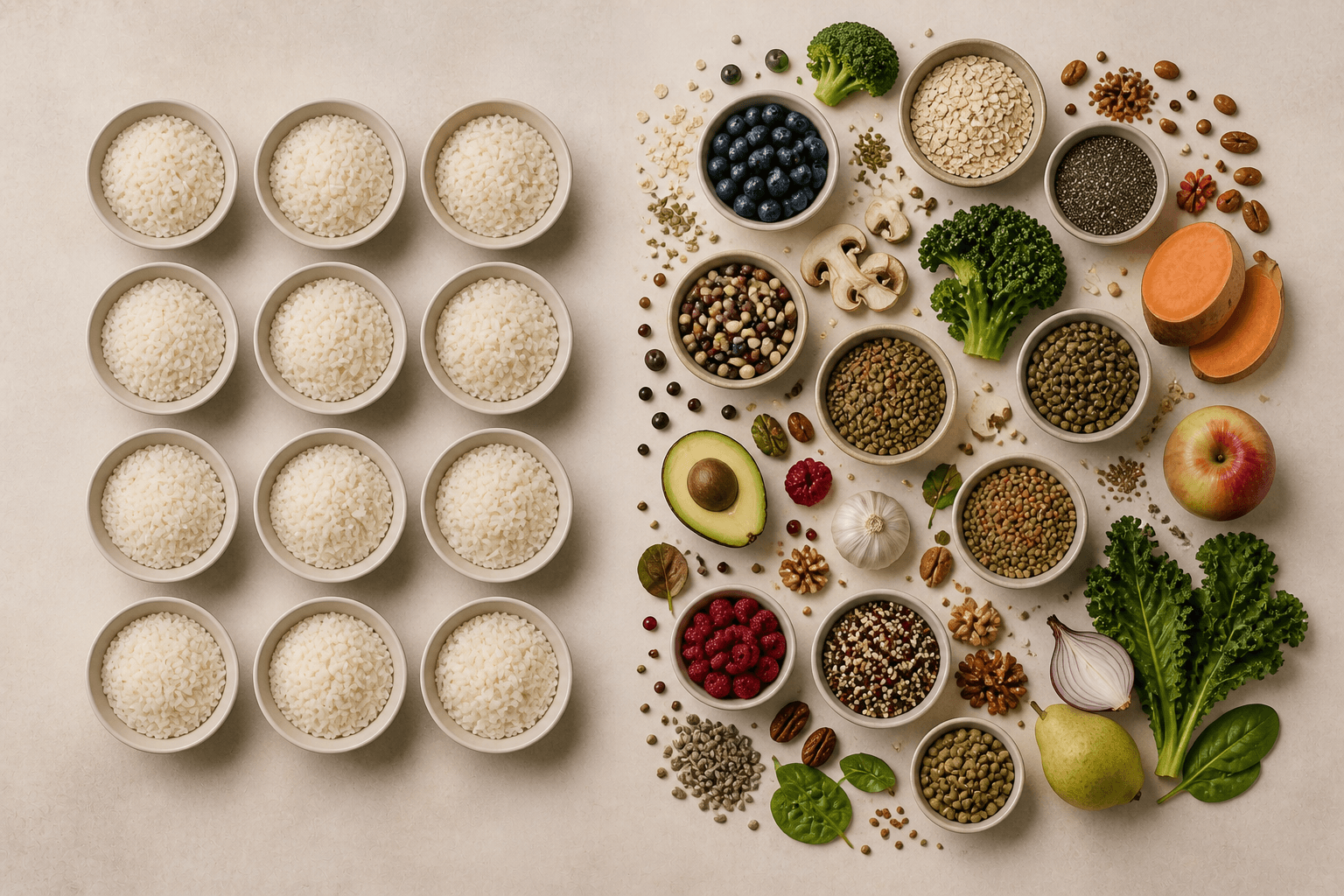
That advice still holds. But there’s a second layer that doesn’t get discussed as often—and it’s where most people get stuck.
A lot of people increase their fiber intake and don’t see much change. Or they feel worse. Or things improve for a while, then plateau. They switch to whole wheat bread and brown rice and maybe add oatmeal in the morning. And then… nothing really changes. At that point, the issue is usually not fiber intake being too low.
It’s the type of fiber—and the pattern of intake.
Why Eating More Fiber Doesn’t Improve Gut Health in Long COVID (PASC)
When you look at the gut microbiome of postviral conditions more closely, the issue isn’t just imbalance. There are fairly consistent shifts in the microbiome, particularly a loss of butyrate-producing species like Faecalibacterium prausnitzii (Giloteaux et al., 2016; Liu et al., 2022). That matters because symptoms are driven less by which bacteria are present and more by what they’re able to produce.
Most people increase fiber in a very narrow way—brown rice instead of white, whole wheat over white, and oats. That usually means a lot of cellulose and some beta-glucan. You can technically be eating a high-fiber diet and still produce very little butyrate, fail to support key microbial functions, and see no meaningful change in symptoms. Different microbes rely on different substrates, and if those substrates aren’t there, nothing really shifts.
Restricted Diets and Gut Dysbiosis in Long COVID and ME/CFS
At the same time, diets tend to become more restricted. Sometimes that’s necessary; sometimes it’s just precaution layered on top of uncertainty, and other times, it's simply low energy for food preparation. But the pattern is predictable: fewer foods, less variety, more reliance on the same “safe” options.
I see this constantly when working with patients. People will remove entire food categories—dairy is a common one—without distinguishing between them. Milk, yogurt, kefir, aged cheese, butter… these are not the same in terms of how they behave in the gut. The result isn’t just symptom management. It’s a microbiome that’s being fed less and less variety. Over time, this leads to what is essentially underfed dysbiosis.
Different Types of Fiber and Their Effects on the Gut Microbiome
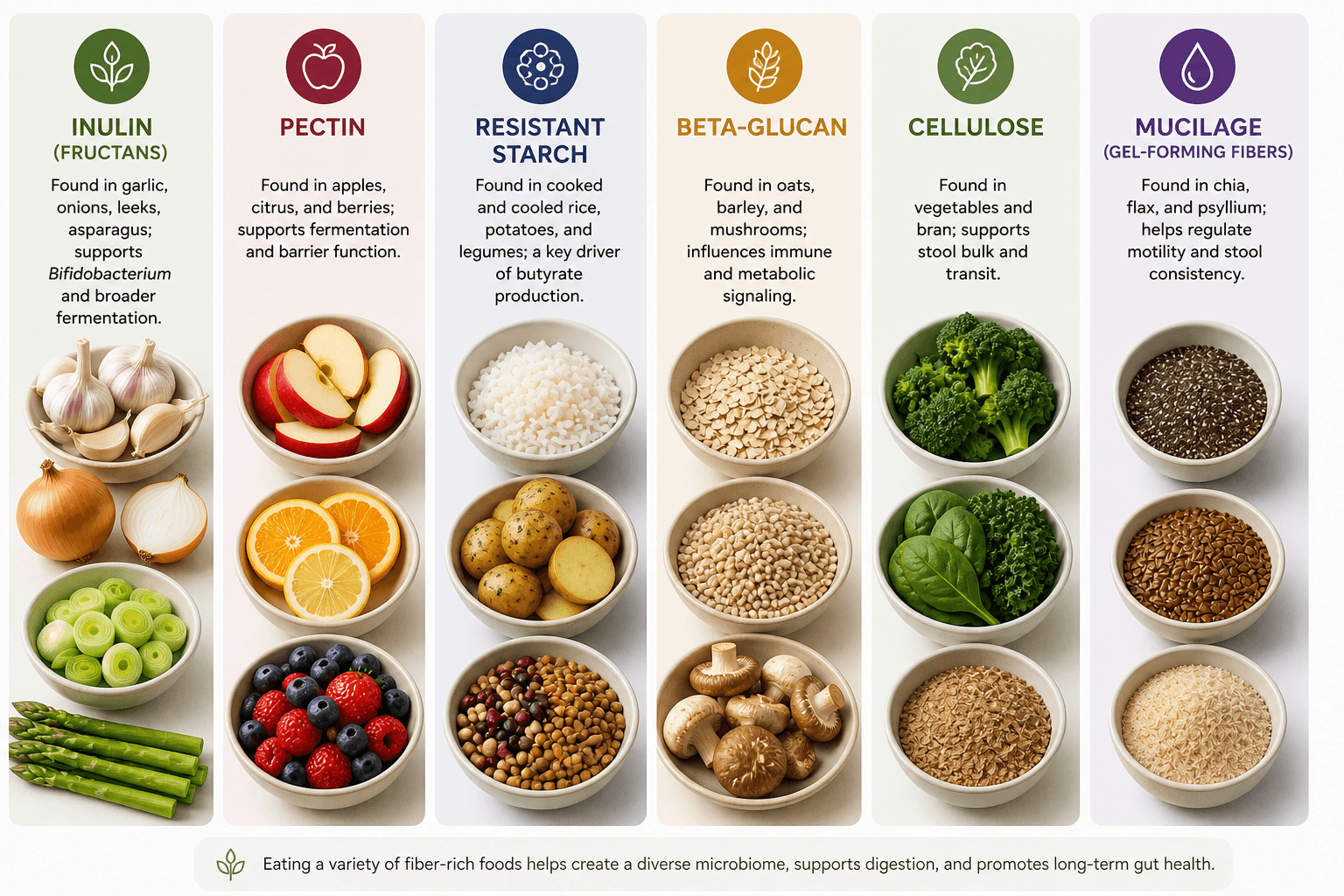
This is where the conversation needs to shift. Fiber isn’t a single input. Different fibers feed different pathways. Some are highly fermentable, some are slower, and some mostly affect transit time or how fast we go.
Those differences determine what gets produced, where it gets produced, and whether it helps or makes things worse.
If you step back, a lot of the common gut-related issues in postviral illness—reactivity, permeability, altered motility, even patterns of overgrowth—start to connect through this lens.
Lower butyrate means a weaker barrier function. Limited fiber diversity reduces microbial competition. Altered fermentation patterns increase reactivity and symptom fluctuation. If viral persistence is part of the picture, it’s happening within that environment. Fiber doesn’t directly treat that, but it does shape the terrain it exists in.
How to Increase Fiber Diversity for Gut Health in Long COVID
In practice, this doesn’t mean dramatically increasing fiber. It means changing the inputs slowly and specifically.
Instead of relying on the same sources, it helps to think in terms of different functional types of fiber:
Inulin (fructans) — found in garlic, onions, leeks, asparagus; supports Bifidobacterium and broader fermentation
Pectin — found in apples, citrus, and berries; supports fermentation and barrier function
Resistant starch — found in cooked and cooled rice, potatoes, and legumes; a key driver of butyrate production
Beta-glucan — found in oats, barley, and mushrooms; influences immune and metabolic signaling
Cellulose — found in vegetables and bran; supports stool bulk and transit
Mucilage (gel-forming fibers) — found in chia, flax, and psyllium; helps regulate motility and stool consistency
Most diets, especially in postviral illness, end up leaning heavily on just one or two of these.
So the goal is not necessarily toward more fiber, but toward a broader range of inputs. That might look like adding chia or flax rather than more grains, incorporating small amounts of resistant starch if tolerated, or including polyphenol-rich foods like berries that support species such as Akkermansia. Not more food—more useful inputs.
And if fiber makes symptoms worse, that’s not something to ignore. It usually means the type doesn’t match the current state of the gut, the dose is too high, or too many changes happened at once. The better approach is slower—one variable at a time, in amounts that are actually tolerated.
Why Fiber Diversity Matters for Gut Health in Long COVID and ME/CFS
When fiber doesn’t help, it’s easy to assume it’s not relevant. But in postviral illness, the same pattern keeps showing up: certain microbial functions are missing, and they’re missing in predictable ways.
If increasing fiber hasn’t made a difference, it may not be about how much. It may be about whether the types you’re using are actually supporting what’s been lost. If you’re trying to sort this out on your own and it still feels unclear, that’s normal. Matching fiber types to your current gut state is not always straightforward—especially when tolerance is limited.
This is something I work through with clients in consultation, where we take a more targeted approach based on symptoms, tolerance, and what’s actually happening in the gut. → Learn more about working with me on gut health and nutrition
FAQ: Frequently Asked Questions About Fiber and Long COVID
-
There isn’t a single “best” fiber. Different types of fiber support different functions in the gut. Fermentable fibers like inulin and resistant starch help support short-chain fatty acid production, while fibers like cellulose and mucilage influence motility and stool consistency. In practice, a mix of fiber types tends to be more useful than relying on one source.
-
Because fiber isn’t one thing. Many people increase fiber in a narrow way—usually with grains or vegetables that are higher in cellulose. That may not support the microbial functions that are actually impaired. In some cases, it can also worsen symptoms if fermentation is occurring in the wrong place or at too high a dose.
-
Fiber can influence dysbiosis, but not in a direct or immediate way. It works by feeding certain microbial pathways and supporting functions like butyrate production, barrier integrity, and microbial diversity. The effect is usually gradual and depends heavily on the types of fiber used and individual tolerance.
-
Certain fibers support the production of short-chain fatty acids like butyrate, which help maintain the intestinal barrier and regulate inflammatory signaling. If these pathways are under-supported, it may contribute to increased gut permeability and downstream immune activation.
-
It depends. In some cases, adding the wrong type or too much fiber too quickly can increase bloating, gas, or reactivity. This is often related to fermentation patterns or underlying overgrowth. A slower, more targeted approach—using smaller amounts and different fiber types—tends to be better tolerated.
-
Different foods provide different fiber types. For example:
garlic, onions, and leeks contain inulin
apples and berries provide pectin
cooked and cooled potatoes or rice provide resistant starch
oats and mushrooms provide beta-glucans
vegetables and bran provide cellulose
chia and flax provide gel-forming fibers
The goal is not to eat all of these at once, but to gradually build variety.
-
Start slowly and change one variable at a time. Introduce small amounts of a new fiber source and assess tolerance before increasing. Avoid making multiple changes at once, as this makes it harder to identify what’s helping or causing symptoms.
-
Not always. While fiber is important for gut health, tolerance varies widely in postviral illness. Some people benefit from increasing fiber diversity, while others may need to adjust types and amounts carefully based on symptoms and gut function.
References
Giloteaux L, Goodrich JK, Walters WA, Levine SM, Ley RE, Hanson MR. Reduced diversity and altered composition of the gut microbiome in individuals with myalgic encephalomyelitis/chronic fatigue syndrome. Microbiome. 2016;4(1):30. Published 2016 Jun 23. doi:10.1186/s40168-016-0171-4
Liu Q, Mak JWY, Su Q, et al. Gut microbiota dynamics in a prospective cohort of patients with post-acute COVID-19 syndrome. Gut. 2022;71(3):544-552. doi:10.1136/gutjnl-2021-325989
Dai ZM, Xu ML, Zhang QQ, et al. Alterations of the gut commensal Akkermansia muciniphila in patients with COVID-19. Virulence. 2025;16(1):2505999. doi:10.1080/21505594.2025.2505999
Zhang F, Wan Y, Zuo T, et al. Prolonged Impairment of Short-Chain Fatty Acid and L-Isoleucine Biosynthesis in Gut Microbiome in Patients With COVID-19. Gastroenterology. 2022;162(2):548-561.e4. doi:10.1053/j.gastro.2021.10.013
Koh A, De Vadder F, Kovatcheva-Datchary P, Bäckhed F. From Dietary Fiber to Host Physiology: Short-Chain Fatty Acids as Key Bacterial Metabolites. Cell. 2016;165(6):1332-1345. doi:10.1016/j.cell.2016.05.041
De Filippis F, Pellegrini N, Vannini L, et al. High-level adherence to a Mediterranean diet beneficially impacts the gut microbiota and associated metabolome. Gut. 2016;65(11):1812-1821. doi:10.1136/gutjnl-2015-309957
Sonnenburg ED, Sonnenburg JL. Starving our microbial self: the deleterious consequences of a diet deficient in microbiota-accessible carbohydrates. Cell Metab. 2014;20(5):779-786. doi:10.1016/j.cmet.2014.07.003