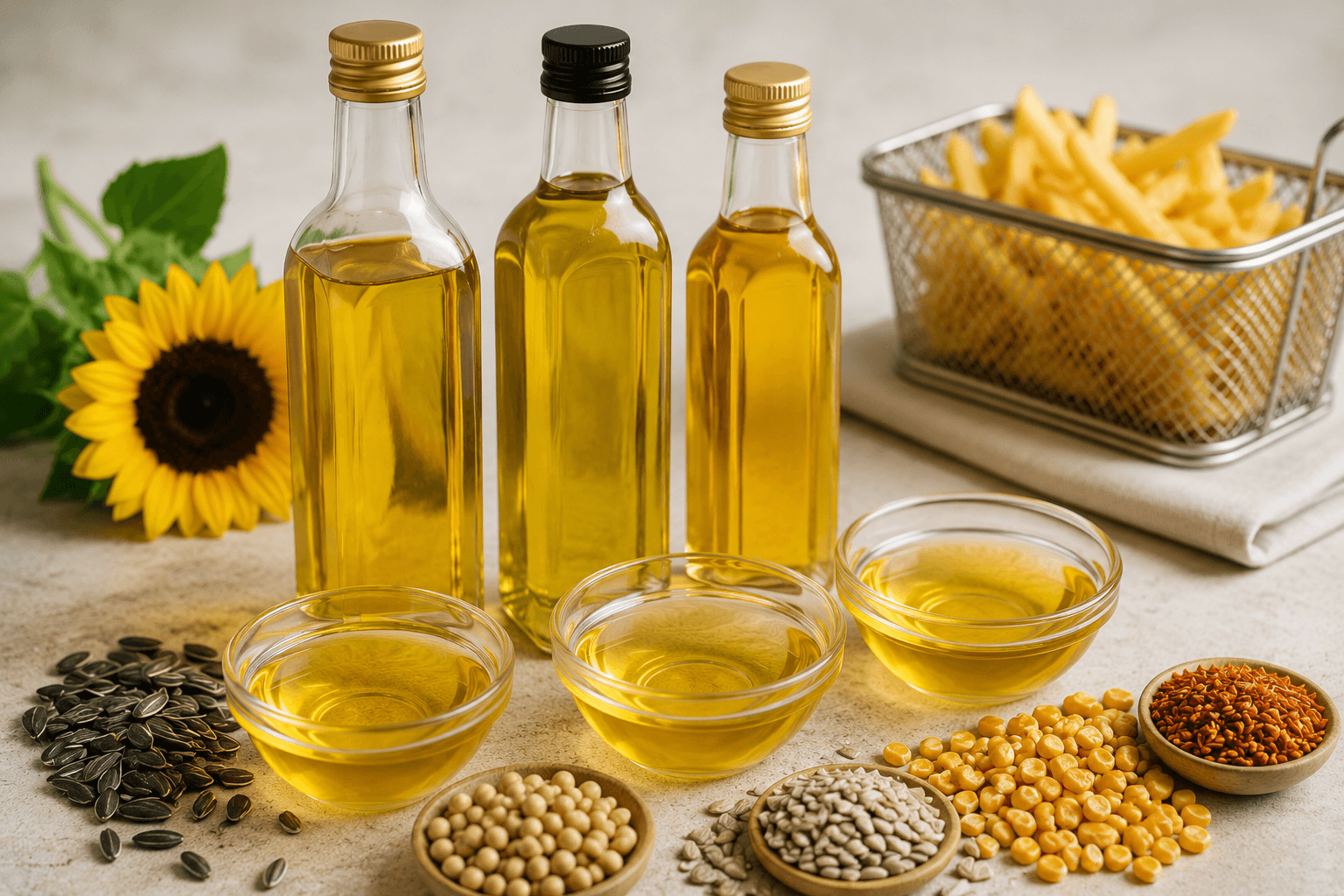
Few nutrition topics generate as much noise online as seed oils. Depending on where you look, they are either treated as ordinary cooking ingredients or blamed for nearly every modern disease. The evidence does not support the more extreme claims made about them.
The more careful answer is less dramatic. Linoleic acid, the main omega-6 fat in most seed oils, has not consistently increased inflammatory markers in controlled human studies. The more defensible concerns are repeatedly heated oils, the ultra-processed foods in which seed oils often appear, and diets that contain very little omega-3 fat.
For people with ME/CFS, long COVID, or fibromyalgia, none of this has been tested directly. That gap matters, but it should not be filled with certainty in either direction.
What Are Seed Oils?
Seed oils include soybean, sunflower, safflower, corn, and grapeseed oil. Most are high in polyunsaturated fat, particularly the omega-6 fatty acid linoleic acid.
Omega-6 fats are not harmful. They are essential nutrients needed for normal cell membranes and immune function.
Not all seed oils are chemically identical, either. High-oleic sunflower and safflower oils contain mostly monounsaturated fat, so their fatty-acid profiles and heat stability more closely resemble olive oil than conventional sunflower or safflower oil. The term “seed oil” therefore groups oils with very different fatty-acid profiles.
Does Linoleic Acid Cause Inflammation?
The concern usually begins with arachidonic acid. Linoleic acid can be converted into arachidonic acid, which the body uses to produce some inflammatory signaling molecules. This makes it sound as though eating more linoleic acid should automatically produce more inflammation. The body is more regulated than that.
In a meta-analysis of 30 randomized trials involving more than 1,300 participants, increasing dietary linoleic acid did not significantly change common inflammatory markers, including CRP, IL-6, and TNF-alpha (Su et al., 2017).
The biological pathway is real, but the expected inflammatory effect has not appeared consistently in human trials. In other words, linoleic acid can contribute to inflammatory signaling, but eating more of it has not reliably raised inflammation markers.
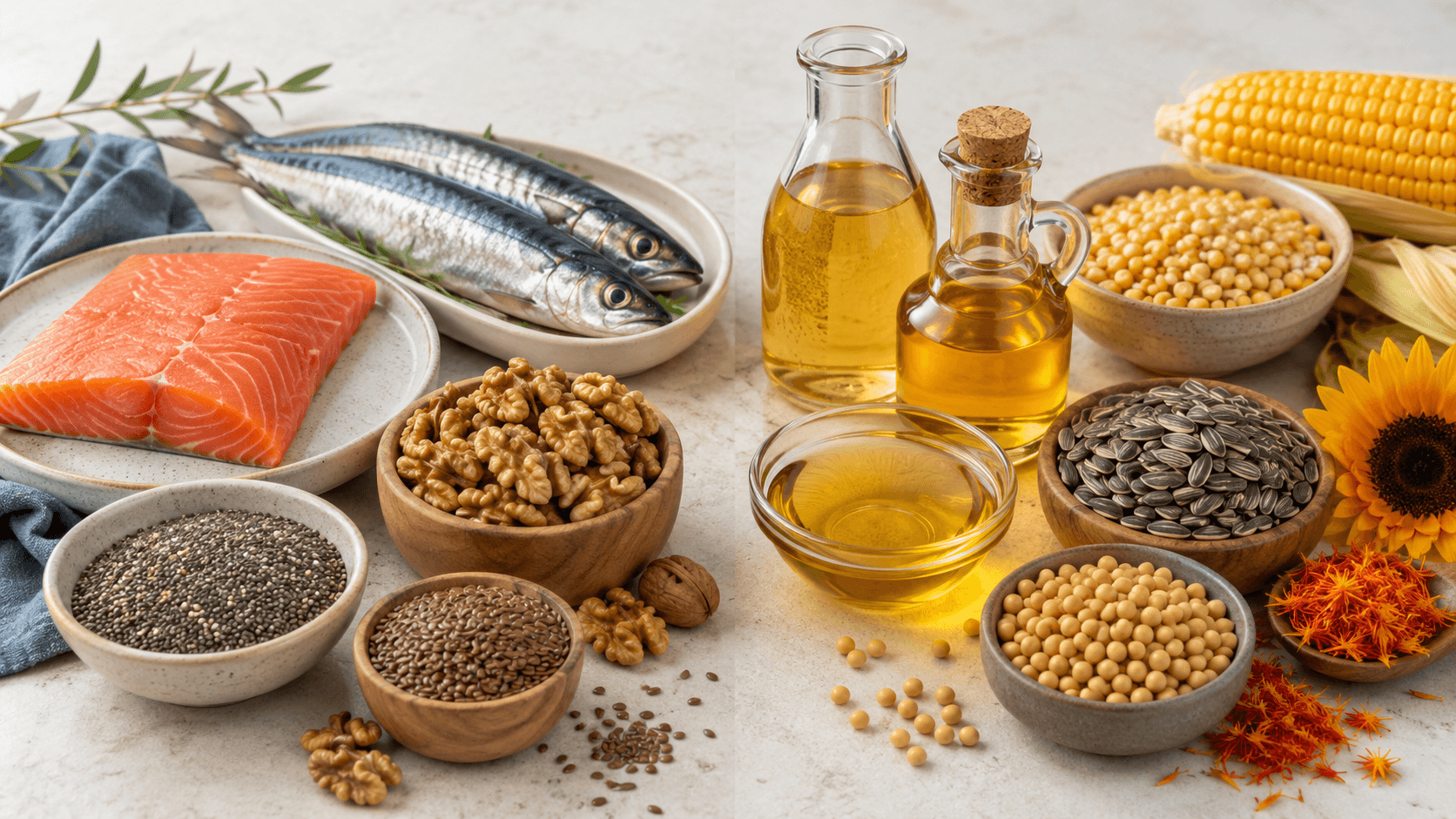
Does the Omega-6 to Omega-3 Ratio Matter?
The omega-6 to omega-3 ratio is often presented as a precise target, sometimes alongside claims about ancestral diets. Those estimates may provide context, but they are reconstructions rather than exact physiological requirements.
The ratio alone cannot tell you whether omega-3 intake is too low, omega-6 intake is unusually high, or both. Two diets can have the same ratio while supplying very different amounts of each fat.
A more practical concern is that many people consume very little of the omega-3’s EPA and DHA because they rarely eat fatty fish. Increasing reliable omega-3 food sources is more useful than trying to calculate an ideal ratio or eliminating seed oils to change it.
What Happens When Seed Oils Are Repeatedly Heated?
Polyunsaturated fats oxidize more easily than monounsaturated or saturated fats, particularly when exposed repeatedly to high heat. Reused frying oil accumulates oxidized lipids and reactive breakdown products, including aldehydes, and the underlying chemistry is well established (Grootveld et al., 2001).
These compounds are potentially harmful because they can react with proteins, cell membranes, and other tissues and may contribute to oxidative stress, impaired blood-vessel function, and inflammatory signaling. That is a different concern from claiming that fresh seed oil or linoleic acid is inherently inflammatory.
The human evidence is less clear. One small study found that a meal prepared with previously used frying fat temporarily impaired blood-vessel function, while another study using repeatedly heated olive and safflower oils did not find the same effect (Williams et al., 1999; Williams et al., 2001).
The sensible conclusion is that repeatedly heating oil degrades its quality and creates compounds with plausible inflammatory and vascular effects. Whether ordinary dietary exposure causes meaningful harm in humans remains uncertain. Reused commercial frying oil is a more credible concern than fresh oil used once for home cooking.
Why Are Seed Oils Linked to Ultra-Processed Foods?
Part of the concern about seed oils comes from where people encounter them most often. They are widely used in packaged snacks, fast food, sauces, and ready-made meals because they are inexpensive, neutral-tasting, and easy to manufacture with. But seed oils are only one feature of these foods. They also tend to be very high in refined sugars and carbohydrates. So, their health effects cannot be attributed to the oil alone.
In a controlled NIH trial, participants ate about 500 more calories per day and gained weight while following an ultra-processed diet, even though the two study diets were matched for several major nutrients (Hall et al., 2019). The study did not identify seed oils as the reason participants ate more. Instead, it showed that people consumed substantially more calories on the ultra-processed diet, even though the researchers had matched the foods offered for calories, macronutrients, sugar, sodium, and fiber.
Seed oils commonly occur in these foods, but focusing on one ingredient can obscure the broader dietary pattern.
What About ME/CFS, Long COVID, and Fibromyalgia?
No study has tested whether reducing seed oils changes post-exertional malaise, fatigue, pain, or autonomic symptoms in ME/CFS, long COVID, or fibromyalgia.
That means there is no evidence-based reason to prescribe seed-oil elimination as a treatment. It also means the effects of very high intake in these conditions have not been directly studied. The fairest conclusion is uncertainty, not alarm without evidence.
Practical Takeaways
There is little reason to fear seed oils in an occasional meal or minimally processed food.
More useful priorities are to:
Eat reliable sources of the omega-3s EPA and DHA, particularly fatty fish when tolerated.
Avoid relying heavily on deep-fried and ultra-processed foods.
Avoid reusing cooking oil.
Use olive oil as a practical everyday option.
Judge the overall food and dietary pattern rather than one ingredient alone.
Bottom Line
Seed oils have been blamed for more than the human evidence supports. Linoleic acid has not consistently increased inflammatory markers in controlled trials. Repeatedly heated oils and the ultra-processed foods in which seed oils often appear are more legitimate concerns than ordinary use of fresh seed oil.
For ME/CFS, long COVID, and fibromyalgia, the direct evidence is still missing. That is a less dramatic answer than either side of the online debate offers, but it is the one that currently holds up.
FAQ: Frequently Asked Questions About Seed Oils and Inflammation
-
Current human evidence does not show that linoleic acid, the main omega-6 fat in most seed oils, consistently raises common inflammatory markers. Concerns are more credible when oils are repeatedly heated or consumed mainly through ultra-processed and deep-fried foods.
-
No study has directly tested whether seed oil intake worsens fatigue, post-exertional malaise, pain, or autonomic symptoms in ME/CFS or long COVID. There is currently no evidence-based reason to eliminate seed oils as a treatment for either condition.
-
Common seed oils include soybean, corn, sunflower, safflower, grapeseed, cottonseed, and canola oil. Their fatty-acid profiles differ, so grouping them together can obscure important differences.
-
Yes. Canola oil is produced from the seeds of specially bred rapeseed plants. It contains less linoleic acid and more monounsaturated fat than many other commonly discussed seed oils.
-
Olive oil is a useful everyday choice because it is rich in monounsaturated fat and relatively stable during cooking. Extra-virgin olive oil also contains polyphenols. This does not mean small amounts of fresh seed oil are inherently harmful.
-
Omega-6 fatty acids participate in inflammatory signaling, but that does not mean eating more omega-6 automatically causes systemic inflammation. Controlled trials have generally not found that increasing linoleic acid raises common blood markers of inflammation.
-
Not necessarily. The ratio alone cannot show whether omega-3 intake is too low, omega-6 intake is unusually high, or both. For many people, eating more EPA- and DHA-rich foods, particularly fatty fish, is more useful than eliminating seed oils.
-
Repeated high-heat use causes polyunsaturated oils to oxidize and form reactive breakdown products. The chemistry is well established, but the clinical effects of ordinary exposure in humans remain uncertain. Reused commercial frying oil is a greater concern than fresh oil used once at home.
-
Not necessarily. Seed oils are common in ultra-processed foods, but these foods also differ in texture, energy density, processing, fiber content, and how quickly they can be eaten. Research has not isolated seed oil as the reason ultra-processed diets can encourage excess calorie intake.
-
There is no strong evidence that most people need to eliminate seed oils completely. A more practical approach is to limit heavily fried and ultra-processed foods, avoid repeatedly reusing cooking oil, include reliable omega-3 sources, and consider the overall dietary pattern.
References
Grootveld M, Silwood CJL, Addis P, Claxson A, Serra BB, Viana M. Health effects of oxidized heated oils. Foodserv Res Int. 2001;13:41-55.
Hall KD, Ayuketah A, Brychta R, et al. Ultra-processed diets cause excess calorie intake and weight gain: an inpatient randomized controlled trial of ad libitum food intake. Cell Metab. 2019;30(1):67-77.
Su H, Liu R, Chang M, Huang J, Wang X. Dietary linoleic acid intake and blood inflammatory markers: a systematic review and meta-analysis of randomized controlled trials. Food Funct. 2017;8(9):3091-3103.
Williams MJ, Sutherland WH, McCormick MP, de Jong SA, Walker RJ, Wilkins GT. Impaired endothelial function following a meal rich in used cooking fat. J Am Coll Cardiol. 1999;33(4):1050-1055.
Williams MJ, Sutherland WH, McCormick MP, Yeoman D, de Jong SA, Walker RJ. Normal endothelial function after meals rich in olive or safflower oil previously used for deep frying. Nutr Metab Cardiovasc Dis. 2001;11(3):147-152.