
Many of the people I work with are already taking an antioxidant supplement by the time we meet, often more than one. They have read that oxidative stress is involved in ME/CFS or long COVID, and taking antioxidants seems like a reasonable response.
But the body’s antioxidant defenses involve much more than the antioxidants we consume. Cells make their own protective compounds, use enzymes to control reactive molecules, and recycle those compounds so they can keep working. Nutrition contributes to each of these processes.
Understanding that system gives us a more useful way to think about food and supplements in ME/CFS and long COVID, also known as post-acute sequelae of SARS-CoV-2 infection (PASC).
💡 Looking for quick answers? Jump to the FAQ
Understanding Oxidative Stress
Cells produce reactive oxygen species, or ROS, during ordinary metabolism. Mitochondria generate some while converting nutrients into usable energy. Immune cells produce them deliberately to help destroy pathogens. In controlled amounts, ROS also carry signals that help cells coordinate their activities.
Some ROS are free radicals: molecules with an unpaired electron that makes them especially reactive. They can react with nearby molecules, changing those molecules and sometimes starting a chain of further reactions. But ROS are not all free radicals, and their presence alone does not mean something is wrong.
The body regulates these reactions through several overlapping defenses. Glutathione, an antioxidant made inside cells, is part of this system. Enzymes help convert reactive molecules into less harmful forms, while other processes recycle antioxidant compounds after they have been used.
Oxidative stress develops when these defenses cannot adequately regulate the reactive molecules being produced. That imbalance can disrupt cell signaling and damage fats, proteins, and DNA. Damage to fats can affect cell membranes, while damage to proteins can interfere with enzymes and other machinery cells need to function (Checa & Aran, 2020).
Oxidative stress and inflammation often occur together, but they describe different processes. Inflammation is an immune response to injury or infection. Immune activity can generate ROS, and oxidative damage can stimulate further inflammatory activity. The two processes can therefore reinforce each other.
Oxidative Stress Research in ME/CFS and Long COVID
Researchers have found signs of oxidative stress in both conditions, although the findings vary with the cells, tissues, and markers being studied.
In a small ME/CFS study, oxidative stress responses to cycling exercise began earlier and persisted longer during the measured recovery period than in healthy participants. The researchers also found changes in the electrical behavior of muscles (Jammes et al., 2005).
These findings raise questions about oxidative stress as a contributor to post-exertional malaise, or PEM: the worsening of symptoms after activity that can be delayed and prolonged. They identify a possible part of the process, rather than a complete explanation for PEM.
A 2025 study examined immune cells from 27 people with ME/CFS, 20 with long COVID, and 25 healthy controls. Researchers found evidence of oxidative stress alongside abnormalities in the pathways that regulate ROS (Shankar et al., 2025).
One finding challenges a common assumption: glutathione was elevated in the cells studied, rather than simply depleted.
The authors suggested that the cells might have been producing more glutathione to compensate for oxidative stress. Having more present did not mean that the overall system was adequately controlling oxidative damage.
These measurements do not describe glutathione levels throughout the body, and other studies have reported different findings. They do show why oxidative stress cannot automatically be interpreted as a shortage of antioxidants.
The Limits of Antioxidant Supplements
When patients hear that oxidative stress is involved in their illness, the next question is often which antioxidant to take. The biological findings alone cannot answer that.
A supplement might influence one antioxidant pathway without addressing what is generating the reactive molecules, how antioxidant compounds are being recycled, or what is happening in the affected tissue. A change in a laboratory marker also does not necessarily translate into less fatigue or fewer PEM episodes.
Broader research illustrates the limits of assuming that antioxidant supplementation must be beneficial. A large Cochrane review examining beta-carotene, vitamins A, C, and E, and selenium found no overall survival benefit in its main random-effects analysis. Some supplements, particularly beta-carotene and vitamin E, were associated with increased mortality in analyses of the more reliable trials (Bjelakovic et al., 2012).
That review examined mortality across other populations, not symptom treatment in ME/CFS or long COVID. Its relevance here is that an antioxidant label does not establish a supplement’s benefit or safety. Individual compounds need their own clinical evidence.
For a broader discussion, see my guide to supplements for long COVID and ME/CFS.
Diet and Oxidative Stress
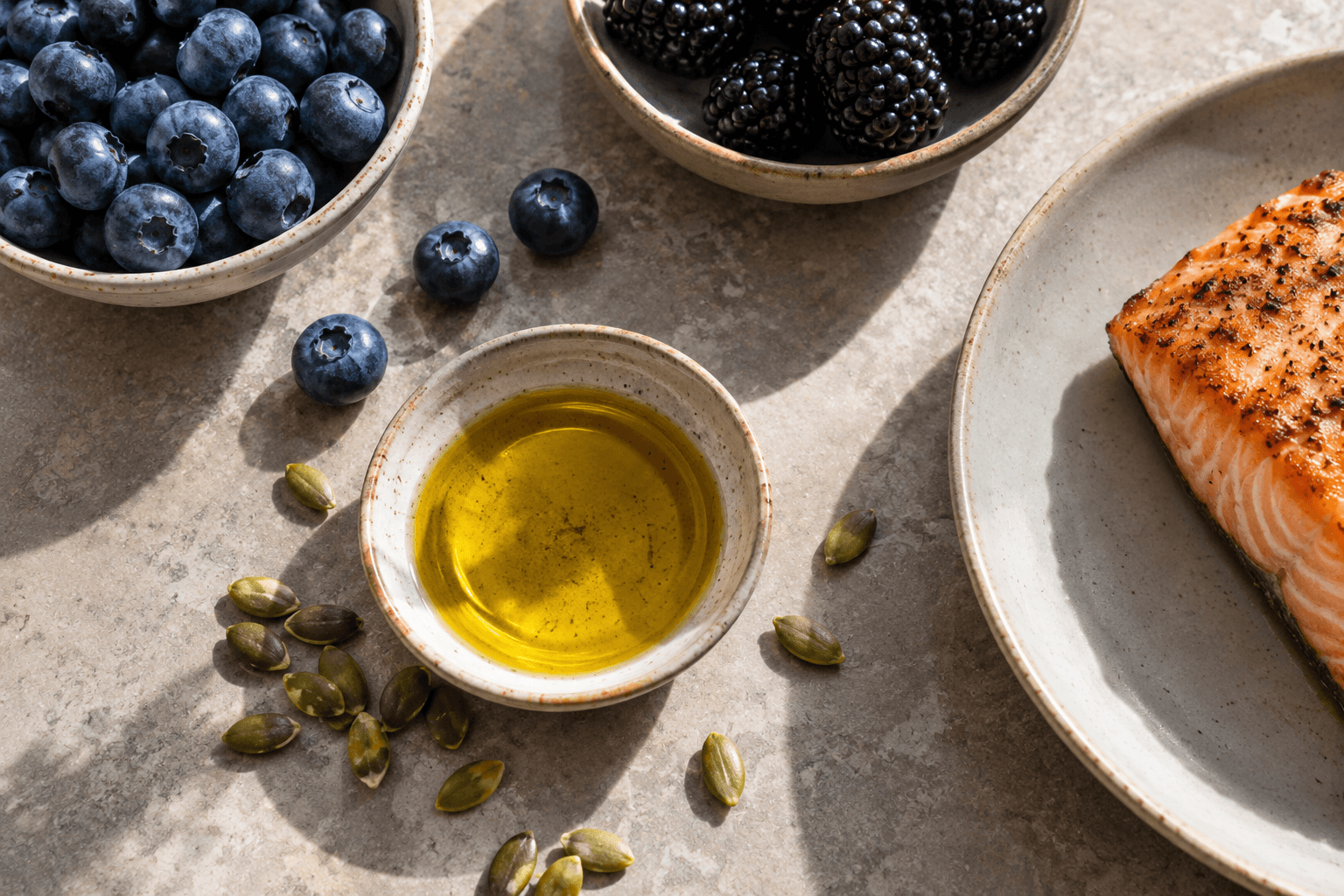
Food influences this system in several ways. It supplies the ingredients needed to make protective compounds, the nutrients required by antioxidant enzymes, and plant compounds that can influence cellular defenses.
Research on overall eating patterns provides some evidence that these connections matter beyond the laboratory.
In a randomized trial involving older Australian adults, a Mediterranean-style diet reduced blood levels of F2-isoprostanes compared with the participants’ usual diets. These compounds form when reactive molecules damage fats, making them useful markers of oxidative damage. Differences were evident at three and six months (Davis et al., 2017).
The intervention included extra-virgin olive oil, vegetables, fruit, nuts, legumes, whole grains, and moderate amounts of fish, poultry, and dairy. It changed the overall eating pattern, so the results cannot be attributed to one antioxidant or food.
Most dietary research in this area comes from people without postviral illness. It shows that diet can influence oxidative damage while leaving open the question of how much those changes improve symptoms in ME/CFS or long COVID.
Nutrition and the Body’s Antioxidant Defenses
Protein supplies the building blocks for glutathione
Glutathione is made from three amino acids: cysteine, glycine, and glutamate. Dietary protein supplies these building blocks, with cysteine often limiting how much glutathione can be produced (Minich & Brown, 2019).
This connection can be overlooked when antioxidant advice focuses mainly on colorful produce. Someone can eat plenty of fruit and vegetables while still obtaining too little protein.
Protein’s role here is to supply material for a compound the body continually makes and uses. Whether glutathione production is actually limited by amino acid availability will depend on the individual. Eating more protein does not automatically increase antioxidant protection when intake is already adequate.
Vitamins and minerals help antioxidant enzymes work
The body also needs nutrients to make its antioxidant machinery function.
Selenium, for example, is required by a group of enzymes called glutathione peroxidases. These enzymes use glutathione to convert certain reactive molecules into less harmful forms, helping protect cells from oxidative damage.
The glutathione used in this process must then be regenerated. Another enzyme performs that work, allowing it to be used again. Riboflavin, or vitamin B2, contributes to this recycling process (Minich & Brown, 2019).
Glutathione therefore does not work alone. Its effectiveness depends on the enzymes that use and regenerate it, as well as the nutrients and cellular resources those processes require. This is why a nutritional assessment needs to consider more than antioxidant intake.
Plant compounds can influence the production of cellular defenses
Some compounds in plant foods influence how cells respond to oxidative stress.
Sulforaphane, formed from compounds in broccoli and related vegetables, has been studied for its effects on a protein called Nrf2. Nrf2 helps regulate genes involved in cellular protection. When activated, it can increase the production of enzymes and other components used to manage reactive molecules.
This is different from an antioxidant directly reacting with a free radical. It involves changing the cell’s own protective response.
The distinction helps explain why food’s effects cannot be reduced to its measured antioxidant content. Preparation, absorption, and dose affect how much of a plant compound reaches cells, and laboratory findings do not establish that ordinary portions of vegetables produce a treatment effect in postviral illness (Houghton et al., 2016).
For more on how sulforaphane influences these protective pathways, read Sulforaphane: Broccoli’s Secret Weapon.
What the Evidence Means for Patients
Oxidative stress is a useful part of the nutrition discussion because it connects what cells are experiencing with what they need to maintain their defenses.
The research supports a broader view than simply consuming more antioxidants. Making glutathione, using it effectively, recycling it, and regulating other protective pathways all involve nutrition. A supplement aimed at one part of that system cannot be assumed to address the whole problem.
For patients, this means that an antioxidant supplement list is an incomplete answer to the research. Nutritional adequacy deserves attention in its own right, especially when illness has reduced appetite, food variety, or overall intake. How much addressing those needs changes postviral symptoms remains an important clinical research question.
For the wider context, read my long COVID diet and nutrition guide.
FAQ: Oxidative Stress, Nutrition, and Postviral Illness
-
Dietary changes have reduced some markers of oxidative damage in studies of people without postviral illness. Whether similar changes reduce oxidative stress or improve symptoms in ME/CFS and long COVID remains uncertain. Nutrition nevertheless supplies the amino acids, vitamins, and minerals needed to maintain antioxidant defenses (Davis et al., 2017; Minich & Brown, 2019).
-
Not necessarily. A 2025 study found elevated glutathione alongside evidence of oxidative stress in immune cells from people with ME/CFS and long COVID. The researchers suggested this might reflect a compensatory response. The findings apply to the cells studied and do not establish glutathione levels throughout the body (Shankar et al., 2025).
-
Finding oxidative stress does not establish that an antioxidant supplement will improve symptoms. Each compound needs to be evaluated through clinical trials that assess benefits and harms. The immune-cell findings discussed here did not test whether taking antioxidant supplements helps patients (Shankar et al., 2025).
-
No. Oxidative stress involves an imbalance between reactive molecules and the defenses that regulate them. Inflammation is an immune response to injury or infection. They can reinforce each other, but they describe different biological processes (Checa & Aran, 2020).
-
It may contribute, but its role has not been established. A small ME/CFS study found that oxidative stress responses to exercise began earlier and persisted longer during the measured recovery period than in healthy participants. This does not demonstrate that oxidative stress explains the delayed, prolonged symptoms of PEM or that antioxidants can prevent them (Jammes et al., 2005).
References
Checa J, Aran JM. Reactive oxygen species: drivers of physiological and pathological processes. J Inflamm Res. 2020;13:1057–1073. doi:10.2147/JIR.S275595
Jammes Y, Steinberg JG, Mambrini O, Brégeon F, Delliaux S. Chronic fatigue syndrome: assessment of increased oxidative stress and altered muscle excitability in response to incremental exercise. J Intern Med. 2005;257(3):299–310. doi:10.1111/j.1365-2796.2005.01452.x
Shankar V, Wilhelmy J, Curtis EJ, et al. Oxidative stress is a shared characteristic of ME/CFS and long COVID. Proc Natl Acad Sci U S A. 2025;122(28):e2426564122. doi:10.1073/pnas.2426564122
Bjelakovic G, Nikolova D, Gluud LL, Simonetti RG, Gluud C. Antioxidant supplements for prevention of mortality in healthy participants and patients with various diseases. Cochrane Database Syst Rev. 2012;(3):CD007176. doi:10.1002/14651858.CD007176.pub2
Davis CR, Bryan J, Hodgson JM, Woodman R, Murphy KJ. A Mediterranean diet reduces F2-isoprostanes and triglycerides among older Australian men and women after 6 months. J Nutr. 2017;147(7):1348–1355. doi:10.3945/jn.117.248419
Minich DM, Brown BI. A review of dietary (phyto)nutrients for glutathione support. Nutrients. 2019;11(9):2073. doi:10.3390/nu11092073
Houghton CA, Fassett RG, Coombes JS. Sulforaphane and other nutrigenomic Nrf2 activators: can the clinician’s expectation be matched by the reality? Oxid Med Cell Longev. 2016;2016:7857186. doi:10.1155/2016/7857186